Milliseconds in the Board Pack: Evidencing Latency Budgets Across UK Hybrid Estates
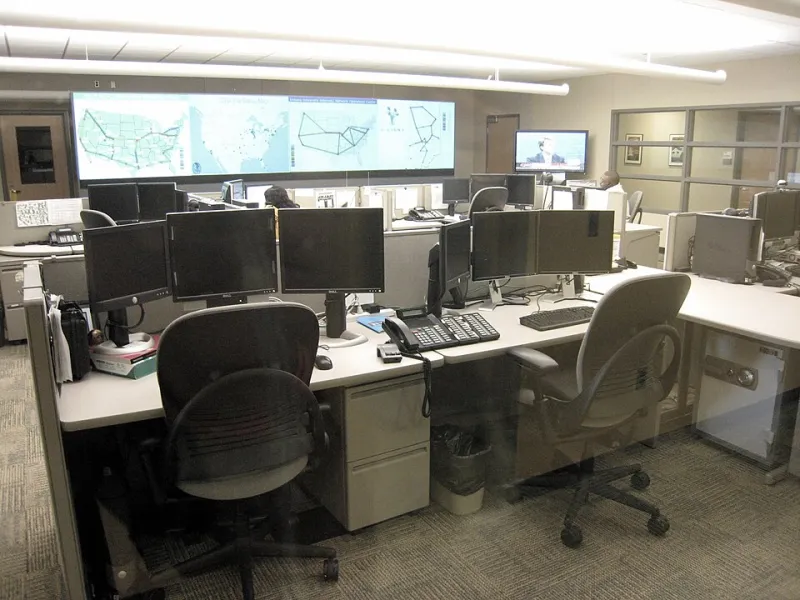
Photo: Alan Levine from United States, CC BY 2.0, via Wikimedia Commons
A service that reports 99.95 per cent availability and takes nine seconds to confirm a customer instruction is not resilient in any sense a customer would recognise. Yet many UK technology functions still report resilience almost entirely in availability terms, because availability is easy to measure and latency is easy to assume. The gap between those two positions is where reputational damage accumulates.
The argument advanced here is not that uptime reporting should be abandoned. It is that uptime alone is no longer a defensible position for a board or an operational resilience committee. Latency is a design constraint with a budget, and budgets require evidence.
Why availability understates the risk
Hybrid estates distribute a single transaction across several domains: a customer-facing tier in a public cloud region, an integration layer on UK colocation, a core platform in a primary data centre, and often a third-party API or two beyond the perimeter. Each hop adds time. Each hop has a different owner, a different contract and a different measurement convention.
The composite effect is that end-to-end latency is nobody's specific responsibility unless it is explicitly assigned. Network teams measure circuit round-trip times. Application teams measure response codes. Platform teams measure ingress latency. None of those measurements, taken alone, tells you what a customer experienced at 14:30 on a Tuesday when the on-ramp was saturated.
Defining the budget per path
A latency budget should be expressed per integration path rather than as a single estate-wide number. The reason is practical: a batch reconciliation feed and a synchronous payment authorisation have wholly different tolerances, and averaging them produces a figure that governs nothing.
For each material path, define four things. The target end-to-end latency under normal conditions. The degraded threshold at which a business process is impaired but still functional. The point at which the path is treated as failed for operational purposes. And the measurement method, including where the clock starts and stops.
The last of these is where most budget exercises founder. If one team measures from the load balancer and another from the client, the numbers will never reconcile, and the resulting debate consumes the credibility of the exercise. Fixing the measurement points is more important than refining the numbers.
Where latency actually leaks
Three locations account for most of the surprises in UK hybrid estates.
Cloud on-ramps and private interconnects are frequently provisioned for bandwidth and monitored for availability, with latency treated as a by-product. In practice, on-ramp latency varies with utilisation, and the variation is often more consequential than the headline figure. A path that sits at 6ms when idle and 40ms under load will break assumptions built on the idle number.
Third-party circuits introduce dependency on carriers whose service level agreements address availability and, at best, mean latency. Tail latency is rarely contractual, and it is tail latency that drives customer complaints. Where a carrier commitment exists, it should be mapped to the budget explicitly so that the gap between contractual and operational tolerance is visible.
Inter-site links between primary and secondary UK facilities carry replication, backup and, increasingly, cross-site application traffic. Replication is usually well understood. Cross-site application traffic is not, and it is the traffic that surges during a partial failover, precisely when every millisecond is contested.
Giving the number an owner
A budget without an owner is a wish. Each path should have a named accountable individual, typically at platform or integration lead level, who signs off the target, reviews the measured position and authorises changes that affect the path.
Ownership should extend to change control. A new service mesh policy, a WAF rule set, an additional TLS inspection hop or an expansion of a logging pipeline can each add latency across many paths at once. Where those changes pass through a forum that knows the budgets, the trade-off is at least explicit. Where they do not, latency accumulates in increments that no single change would justify.
Testing against real integration paths
The evidence that matters is measured on the paths that carry production traffic, using representative payloads and realistic concurrency. Synthetic pings between data centres are useful for baseline monitoring and near-useless as evidence of user experience.
A practical regime runs continuous lightweight measurement at defined points, supplemented by periodic full-path transaction tests that exercise authentication, reference data lookups, downstream writes and response assembly. The periodic tests should be scheduled to include peak periods, not only quiet overnight windows where every estate looks healthy.
Results should be recorded with date, path, measured percentile and the corresponding budget. Percentiles matter: reporting averages conceals the tail, and the tail is what customers experience during busy periods. Ninety-fifth and ninety-ninth percentile figures against budget make a far stronger board statement than a mean.
The reporting artefact
For an operational resilience committee, a one-page latency position per important business service is usually sufficient. It should show the paths comprising the service, the budget and current measurement for each, the trend over the preceding quarter, and any open remediation with a date and owner.
That artefact does something availability reporting cannot. It demonstrates that the organisation understands the time-based behaviour of its dependencies, has set tolerances deliberately, and can show measured evidence against them. In an environment where UK regulators expect firms to test their important business services against severe but plausible scenarios, latency evidence is among the most straightforwardly obtainable and most frequently omitted.
Starting modestly
No organisation needs to budget every path at once. Select the three or four services whose degradation would be most visible externally, define budgets for their constituent paths, fix the measurement points and run for a quarter. The exercise will surface at least one path where the assumed latency and the measured latency diverge materially, and that finding alone justifies the work.